How Many Outlets Can Be on One Circuit?
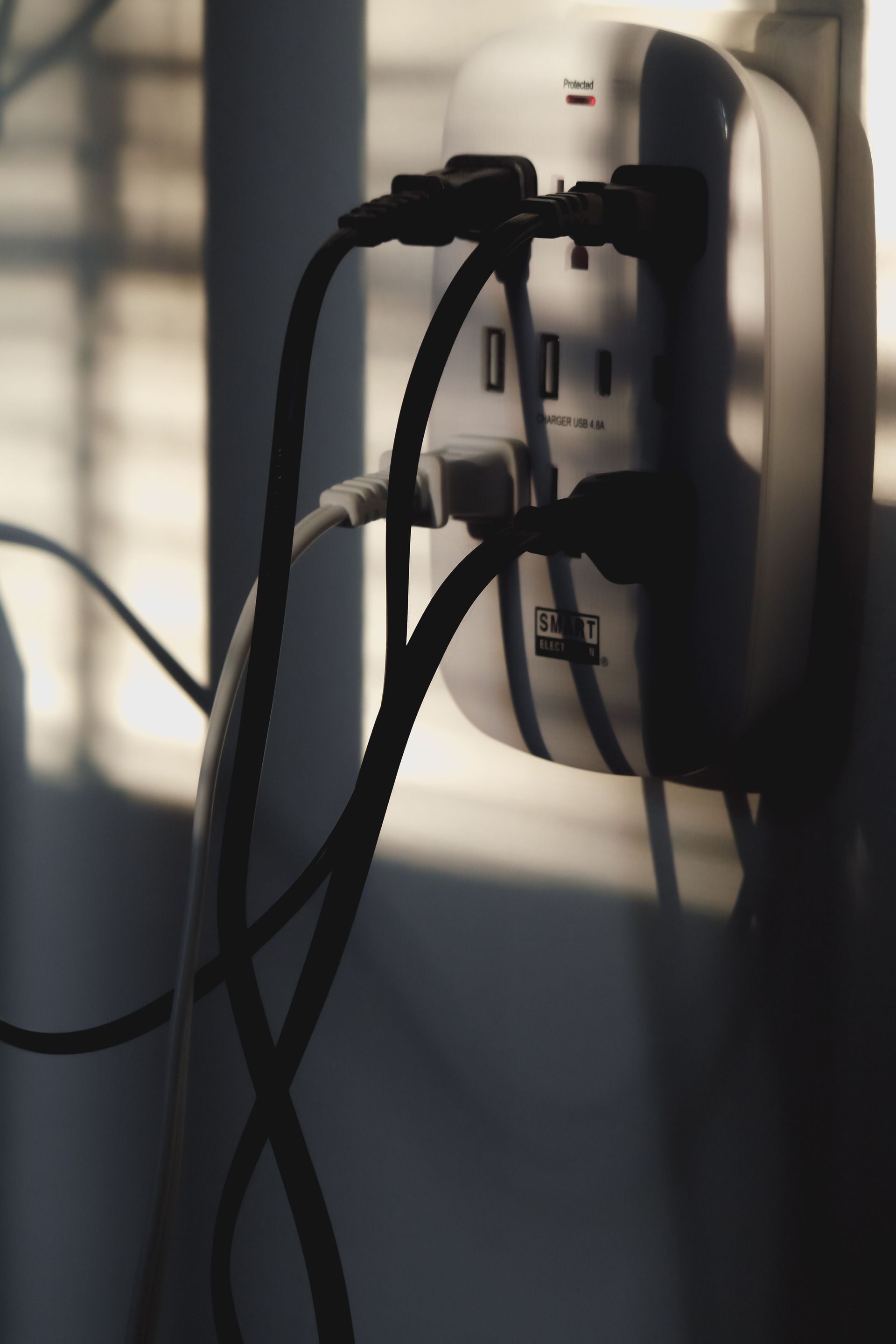
In a standard Arizona home, the practical answer is up to eight outlets on a 15-amp circuit and up to ten on a 20-amp circuit. The National Electrical Code puts no hard number on general-purpose residential outlets, so that limit is a working rule electricians use to keep the load reasonable rather than a line in the book.
This question comes up constantly, usually right after somebody adds a garage freezer or a home office and the breaker starts complaining. Worth separating from a close cousin: this article is about how many receptacles belong on one circuit. If your breaker is already tripping, the cause is usually load or a fault rather than outlet count, and we cover that in why your circuit breakers keep tripping.
What the Code Actually Says, and What It Does Not
Here is what surprises people. For general-purpose receptacle circuits in a house, the NEC sets no maximum number of outlets. It governs spacing, which rooms need dedicated circuits, and not loading a circuit past 80 percent of its rating continuously. Commercial work assigns a fixed load per receptacle; residential leaves it to judgment. Eight and ten come from that 80 percent rule. A 15-amp circuit at 120 volts gives you 1,800 watts, and 80 percent of that is 1,440 watts. A 20-amp circuit gives you 2,400 watts, with 1,920 usable. Assume roughly 180 watts per outlet as a planning number and you land at eight and ten. It is a rule of thumb built on an assumption, and the assumption is that nothing plugged in is a hog.
Where Arizona Homes Break the Rule of Thumb
That planning number falls apart fast in a Valley house. A few examples from around Buckeye and the West Valley:
• Garage freezers and second refrigerators. A compressor starting in a 115-degree garage draws a real surge.
• Space heaters in January. People forget these because it is Arizona, but a 1,500-watt heater is nearly the whole usable capacity of a 15-amp circuit.
Count matters less than what is on it. Twelve outlets running lamps is a calmer circuit than four where one has a space heater.
An overloaded circuit does not just trip breakers. It can also make outlets arc at the contacts. If you are noticing flashes when you plug things in, our post on why an outlet sparks when you plug something in explains what is happening inside the box and when to call.
Which Circuits Have to Stand Alone
Some circuits are not up for negotiation:
• Kitchen countertop receptacles need at least two dedicated 20-amp small appliance circuits, and those cannot feed anything outside the kitchen and dining area.
• The laundry area and the bathroom receptacles each get their own dedicated 20-amp circuit.
• Large fixed appliances like a dishwasher, garbage disposal, microwave, or EV charger each get their own. When somebody asks us to add a kitchen outlet, the first thing we check is whether the nearest circuit is one of these, because you cannot just tap the closest box.
The rules change completely once a big appliance enters the picture. Refrigerators, dishwashers, microwaves, dryers, water heaters and EV chargers are not supposed to share a circuit with anything at all. We cover which ones must stand alone and how to check yours in our post on whether your appliance needs a dedicated circuit.
A Job From Last Spring
A homeowner in Buckeye called because his home office outlets kept dying at seemingly random times. Tracing the circuit, we found it fed six outlets across two bedrooms and the hallway plus, thanks to an old garage remodel, one garage outlet with a chest freezer on it. On a normal day it sat well under its limit. When that freezer compressor kicked on at the same moment as his laser printer, the breaker had had enough.
We ran a new dedicated 20-amp circuit to the garage for the freezer and left the office alone. Half-day job, problem never came back. That is a typical outcome and the sort of thing our residential electrician team sorts out most weeks.
The Honest Counterpoint: More Outlets Is Not Always the Answer
Not every dead outlet needs a new circuit. Often it is a single failing receptacle, a backstabbed connection that worked loose over twenty years, or a tripped GFCI in another room. We would rather find that in twenty minutes than sell you a circuit you do not need. We do not upsell.
The other direction matters too. Sometimes people want a new circuit when the real problem is upstream. If the panel is already full, if an older 100-amp service is feeding a house that has since added an EV charger and a pool pump, or if it is one of the panel brands that should not still be in service, adding one more circuit is a new tire on a bad axle. That is an electrical panel and circuit services conversation first.
Talk to an Electrician Before You Add the Load
If you are planning a garage freezer, a workshop or a home office that will lean on an existing circuit, get it looked at first. It is a short visit and it beats finding out the hard way in July.
Call Oliver Electric at 623-387-9171. Family-owned, founded by Johnny Oliver in 2006 with his sons Justin and John in the business today, ROC #229347, and we answer 24/7 for emergencies. Whether it is outlet and switch work or a new circuit, we will tell you straight what you need.
Frequently Asked Questions
How many outlets can be on a 20-amp circuit?
Ten is the common working limit. The code names no number for houses, so ten comes from roughly 180 watts per outlet against the 1,920 usable watts on a 20-amp circuit. If any will carry a heavy continuous load, plan on fewer.
Can lights and outlets share the same circuit?
In a house, yes, and it is common in older Arizona homes. It is allowed and usually fine, since LED fixtures draw very little. The annoyance is practical: when that circuit trips you lose the room lights at the exact moment you are trying to find the panel.
How do I tell which outlets are on the same circuit?
Turn off one breaker, then walk the house with a lamp or an outlet tester and note what went dead. Label the panel as you go. Tedious once, useful forever. If your labels are wrong or missing, common in remodeled homes, we map it properly as part of a full electrical inspection.
Contact Oliver Electric in Buckeye, AZ
Oliver Electric LLC
18927 W Latham St
Buckeye, AZ 85326
Phone:
623-387-9171
Stay connected with Oliver Electric for electrical tips, project updates, and helpful information for homeowners and businesses.
Follow Oliver Electric Online:
Facebook | X | Instagram | YouTube
Worked with Oliver Electric?
Leave us a review on Google Maps